
From Ember
When should I anchor furniture for a baby?
Last checked: 13 August 2026
All guides/When should I anchor furniture for a baby?
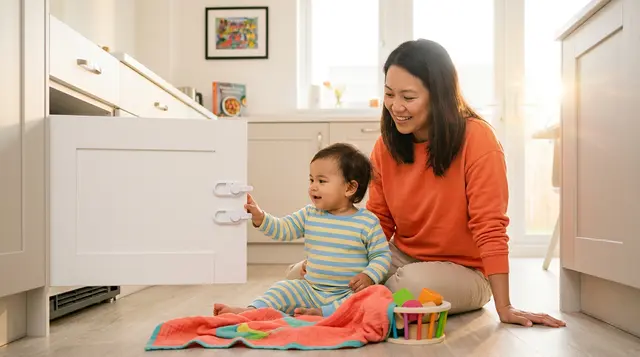
They are getting stronger, and drawer handles suddenly look like ladder rungs. This page is about when wall-fixing makes sense, what to fix first, and why “it is solid” is a weak test. It is not a shopping roundup of straps.
If you’re new here: Ember is a UK parenting app for babies and toddlers. We write guides like this so you get a clear answer and can get on with your day. When you want practical ideas matched to your child’s age, the free Ember catalogue is there to browse. This page is just about when to wall-fix furniture for a baby or toddler.
When should I anchor furniture?
Before or when they pull to stand on the sofa, a drawer handle or a bookshelf. CAPT times fall prevention to movement: as soon as your baby starts moving around, the house needs a different look. Waiting until they “look like a climber” is late.
A birthday is a weak trigger. Some babies haul up at seven months. Others sit late and then climb everything in one week. The same weekend you notice pulling to stand, treat drawers and tall units as climbable, and fit stair gates if you have stairs. Ember’s stair-gate page covers top and bottom gates in more detail.
“It feels heavy” is not a safety test. A toddler hanging on an open drawer changes the centre of gravity. RoSPA’s furniture and TV tip-over advice exists because weight alone does not keep a piece upright.
Real prompts versus a weak prompt
Watch what their body can do this week. Furniture tip-overs track climbing skill, not a month on the calendar.
| This is a real prompt | This is a weak prompt |
|---|---|
| They pull to stand on a drawer, sofa arm or shelf edge | Waiting until they can walk across the room |
| Open drawers make a step ladder they can climb | Skipping fixings because the unit “feels heavy” |
| A flat-screen TV on a low stand they can grab | Buying decorative straps that never get screwed into the wall |
| Low furniture under a window they can climb toward | Assuming only upstairs windows matter |
What should I fix first?
Start with anything tall, tippy, or tempting to climb. RoSPA flags chests of drawers, bookcases, wardrobes and free-standing TVs. NHS safer-home advice also keeps low furniture away from windows so they cannot climb out.
- Chests of drawers and tallboy units: open drawers are footholds.
- Bookshelves and freestanding wardrobes, even if they are full of books.
- Flat-screen TVs on stands: RoSPA advises a wide stable base plus anti-tip straps tethered to the wall, or a proper wall mount into studs.
- Tall kitchen units and changing tables that rock when pulled.
- Move toy boxes and nursing chairs away from window sills. CAPT: even a ground-floor window is a fall. Blind cords get tied up high.
Pressure straps versus screw fixings?
Use the brackets or straps that came with the furniture, or proper wall fixings for your wall type, screwed into something solid. A pressure-only gadget that squeezes between wall and unit is a weak substitute for a screw into a stud or a rated plasterboard fixing.
Follow the manufacturer’s instructions. On plasterboard, fix into studs where you can. If you are unsure about the wall, get someone who knows the house fabric to help. The same logic as a top-of-stairs gate applies: the barrier only works if it is fixed properly.
Do the job once, then give the unit a firm tug yourself. If it walks or tips toward you, the fixing is not done. Ember’s note: this is a boring Saturday job that still matters years later.
How does this sit beside stair gates?
Gates cover the stairs. Anchors cover the climbable furniture in every room. You usually need both once they are on the move. According to the NHS, fit safety gates that meet BS EN 1930:2011 at the top and bottom of stairs, and keep furniture away from windows.
- Fit gates before they crawl unsupervised onto the stairs. See Ember’s when-do-babies-need-stair-gates page for timing and take-down rules.
- Wall-fix tippy pieces in the same sweep: lounge, bedroom, nursery.
- Once they can stand in the cot, take out large cot toys they could climb on. NHS and CAPT both flag this.
- Stay close while they practise climbing sofas with you. Anchors reduce tip-over risk; they do not replace watching.
A short list you can screenshot
One weekend sweep before or when pulling to stand starts.
- Drawers and bookcases that can tip: screw-fixed to the wall
- TV strapped or wall-mounted properly
- Low furniture moved away from windows; restrictors or locks on
- Blind cords tied up high, nothing dangling within reach
- Large cot climb-ons removed once they stand
- Stair gates fitted if you have stairs
- Ignore “it feels heavy” as a reason to skip
A few quick answers
When should I anchor furniture for a baby?
Before or when they pull to stand. CAPT times fall prevention to movement. Do not wait for a birthday or for the furniture to feel light when you shove it.
Is furniture anchoring as important as a stair gate?
Yes. Public Health England says most fall admissions in under-5s are from furniture. RoSPA says unsecured drawers and TVs pull over when a child climbs. Do both jobs in the same season.
Do pressure-mounted furniture straps count?
Prefer screw fixings into a solid wall or rated plasterboard fixings, following the product’s fitting instructions. Anything that only squeezes and can slip is a weak answer for a climbing toddler.
What about rented homes?
Ask the landlord about approved wall fixings and how to make good later. Tip-over risk does not pause for a tenancy. Temporary soft options are a poor substitute for a proper screw fix where you can get permission.
If you want the next practical ideas for this age, browse the free Ember catalogue for babies around 9 to 12 months. Furniture wall-fixings, stair-gate placement and climbable corners live there.
Browse the free catalogue · ideas for babies around 9 to 12 months →
Sources
- NHS: Baby and toddler safety — Furniture away from windows; window locks; remove cot climb-ons; stair gates BS EN 1930
- CAPT: How to prevent falls in children — Gates and fall prevention as soon as they move; windows even on the ground floor; cot toys out once standing
- RoSPA: Accidents to children — Furniture and TVs wall-fixed; drawers as climbing frames
- RoSPA: Flat-screen TV safety — Stable base, anti-tip straps to the wall, or wall mount into studs
- OHID: Preventing unintentional injuries (under-5s) — Most fall admissions from furniture; window locks as they climb
We link to official sources below. Check the live pages for the latest guidance.