
From Ember
When should my baby start solids? UK readiness signs that matter
Last checked against NHS pages: 29 July 2026
All guides/When should my baby start solids? UK readiness signs that matter
Around six months, when three readiness signs appear together, is the usual UK picture. Here is how to read those signs without chasing early labels, then what helps on the first tastes days.
If you’re new here: Ember is a UK parenting app for babies and toddlers. We write guides like this so you get a clear answer, with NHS detail behind it, and can get on with your day. When you want practical ideas matched to your child’s age, the free Ember catalogue is there to browse. This page is just about starting solids.
When should my baby start solids in the UK?
According to the NHS, you should wait until your baby is around 6 months old before starting solid foods. Early on, how much they eat matters less than getting used to tastes and textures. Milk still supplies most of their energy and nutrients.
The NHS also asks you to wait even if a jar or packet says “from 4 months.” Those labels are not the green light. If your baby was born early, ask your health visitor or GP — timing can differ.
Why wait until around 6 months?
According to NHS Best Start guidance, waiting gives your baby time to develop so they can cope with solid food. Milk covers nutrition needs until around then for most babies, and many are better able to sit, feed themselves, move food around their mouth, and swallow — which can mean mashed, lumpy or finger foods sooner, without needing only smooth blends.
What are the three signs my baby is ready?
According to the NHS, three signs together, from around 6 months, usually mean your baby is ready for first solids alongside milk:
- They can stay in a sitting position and hold their head steady.
- They can coordinate eyes, hands and mouth: look at food, pick it up, and bring it to their mouth.
- They can swallow food rather than push it straight back out.
Ready signs vs easy-to-misread signs
A single grab at your toast is lovely. It isn’t the whole picture on its own — you’re looking for that little set of skills together. Other NHS pages note it’s rare for all three to appear together before six months.
| Ready signs (together, ~6 months) | Easy to misread |
|---|---|
| Sits and holds head steady | Chewing fists |
| Eyes–hands–mouth coordination with food | Waking more at night |
| Can swallow food (not only spit it back) | Wanting extra milk feeds |
What if they are not ready yet?
You’re still heading toward family mealtimes. Until those three signs line up around six months, milk remains the main feed.
In the meantime you can offer a little extra milk if they seem hungrier, let them sit with you at the table so mealtimes feel familiar, and skip starting early “so they sleep.” If you’re unsure, ask your health visitor — that’s what they’re for.
How should we set up first tastes?
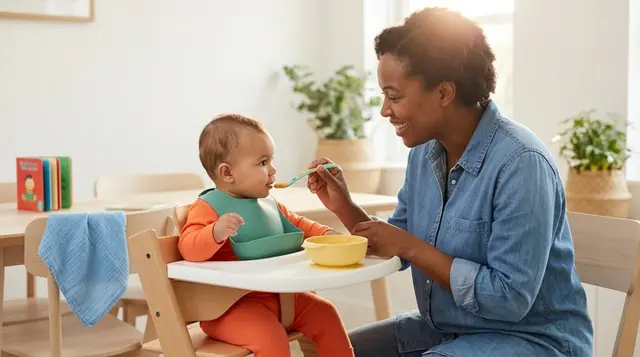
Keep early sessions small and unrushed. According to NHS advice, offer a little food before a usual milk feed so they are interested rather than frantic, and stop when they turn away or close their mouth. No forcing bites.
- Seat them upright with a securely fitted highchair harness, and stay with them while they eat.
- Cool and test food before offering it.
- Keep hard foods (whole nuts, raw hard carrot or apple) off early plates.
- Cut small round foods such as grapes and cherry tomatoes into quarters.
- Remember gagging (eyes watering, tongue pushing food forward) is common while they learn; choking is different — stay close.
- Do not add salt or sugar (including stock cubes and gravy); no honey before age one.
- Spoon, fingers, or a mix can all work — babies don’t need baby rice to “start solids” or sleep better.
Checklist
A short list for the fridge or Notes app before you buy another “stage 1” jar.
- Around six months (or health-visitor advice if premature)
- Not starting just because a label says “from 4 months”
- Sits with support and holds head steady
- Eyes–hands–mouth coordination for food
- Can swallow food (not only spit it back)
- Not starting only because of fist-chewing, night waking, or “more milk means solids”
- Highchair upright + harness on; you stay with them
- No added salt/sugar; honey off the menu under one
- Grapes/cherry tomatoes quartered; hard foods avoided
- Time protected — no rush, no force
A few quick answers
When should my baby start solids?
Around 6 months in the UK, when the three NHS readiness signs appear together. Ask your health visitor if your baby was premature.
Can I start at 4 months if the packet says so?
NHS Best Start advice is to wait until around 6 months even if labels say suitable from 4 months.
Will solids help them sleep through?
According to NHS guidance, starting solid foods will not make your baby more likely to sleep through the night.
Do I have to choose baby-led weaning or purées?
No. The NHS says finger foods, spoon-feeding, or a mix can all be fine, as long as they get a wide variety of food over time.
What about baby rice in a bottle?
The NHS says babies don’t need baby rice to move to solids or sleep better, and bottles should only have breast milk or infant formula.
That’s the solids call in plain English. When you want more practical ideas for babies around this age, browse the free Ember catalogue.
Browse the free catalogue · ideas for babies around 4 to 6 months →
Sources
- NHS — Your baby’s first solid foods — Timing ~6 months; three signs; mistaken signs; first-session pace; seating; methods
- NHS Best Start — How to start weaning — Why wait; wait even if labels say from 4 months; premature advice
- NHS — Foods to avoid — Salt, sugar, honey, and related cautions
We link to official sources below. Check the live pages for the latest guidance.