
From Ember
Do you need a baby monitor before birth (UK)?
Last checked: 9 August 2026
All guides/Do you need a baby monitor before birth (UK)?
Shops put monitors next to the Moses baskets, so the pair looks like a set. Start with a safe sleep space in your room. You can add a monitor once you know whether you can hear them from the kitchen.
If you’re new here: Ember is a UK parenting app for babies and toddlers. We write guides like this so you get a clear answer and can get on with your day. When you want practical ideas matched to your child’s age, the free Ember catalogue is there to browse. This page is just about whether you need a baby monitor before birth.
Do you need a baby monitor before birth?
Usually no. According to the NHS, the safest place for your baby to sleep is in a separate cot or Moses basket in the same room as you, for every sleep, for at least the first 6 months. A newborn in your room is already close enough to hear. A monitor is extra for later, when you are often in another room.
Ember’s view is hold off until you know the house. You will learn whether stairs swallow sound, whether the kitchen is too far, and whether twins mean you are often in two places. That is kinder than buying a gadget you then ignore for months.
What does NHS safer sleep actually ask for?
According to NHS guidance, place your baby on their back to sleep, feet to the foot of the cot or Moses basket, on a firm flat mattress, with a clear sleep space. Keep them in the same room as you for at least the first 6 months, day and night. The Lullaby Trust says the same: a monitor can never replace a parent or carer being in the room.
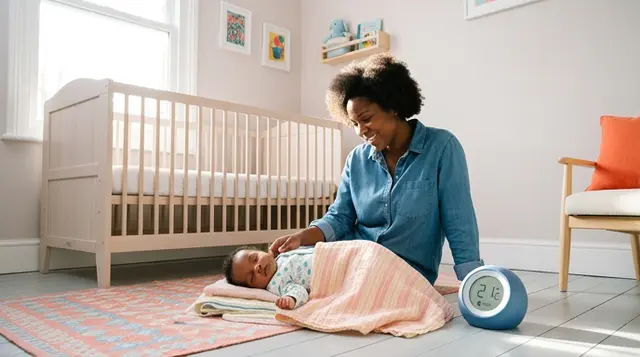
Clear means no pillows, duvets, cot bumpers, loose blankets, soft toys, or anything meant to hold them in place, such as pods or nests. A room thermometer helps you keep the room around 16–20°C. That is not the same job as a baby monitor.
What a monitor can help with later
A monitor is a hearing (or seeing) tool. Safer sleep is still the sleep space, the position, and you being nearby.
| A monitor can help with | Safer sleep still needs |
|---|---|
| Hearing a cry from the kitchen, garden or upstairs later on | Same-room sleep for at least the first 6 months |
| A screen or flash if you cannot hear a cry well | Baby on their back in a clear, firm, flat sleep space |
| Twins or a layout where you cannot stay close all day | You nearby for sleeps, not a gadget in your place |
When would we buy one later?
Wait until you have lived in the house with the baby for a bit. Then buy only if you can name the gap.
- You cannot hear a cry from the kitchen, garden, or another floor.
- Hearing loss, where a visual or vibrating alert actually helps you respond.
- Twins or more, when you are often moving between rooms while one baby sleeps.
- After the early months, when they start some sleeps in another room. NHS same-room advice still covers at least the first 6 months.
If we do buy a monitor, what kind?
According to the Lullaby Trust, there is no research showing baby monitors help prevent sudden infant death syndrome (SIDS). Follow safer sleep whether you own one or not. Simple audio is enough for many families who just want to hear a cry from another room. Video helps if you cannot hear well, or you want to glance without walking in.
Movement or “breathing” pads are a different product. The Lullaby Trust says many sold for reassurance are not certified medical devices. If you choose one, they recommend looking for an MD or medical device mark, plus a UKCA or CE mark, and keeping the control unit out of reach. Stop skin-contact wired types after about 6 months, or when your baby can roll, reach and grasp. Know what you will do if an alarm sounds: check your baby, and call 999 if they do not respond.
Checklist
A short list before you add a monitor to the basket.
- Safe sleep space ready: back, firm flat mattress, clear, same room
- NHS same-room sleep planned for at least the first 6 months
- Hold off on a monitor until you know the layout and your hearing
- If you buy later, name the gap (distance, hearing, twins)
- A monitor does not replace you being nearby
- Room thermometer is a different tool from a baby monitor
- If you use a movement monitor, check medical-device marking and the maker’s instructions
A few quick answers
Do I need a baby monitor before my baby is born?
Most UK homes do not. NHS safer sleep is same-room sleep for at least the first 6 months. Buy a monitor later if you cannot hear them from another room, or hearing or twins makes staying close harder.
Does a baby monitor prevent SIDS?
The Lullaby Trust says there is no research showing monitors help prevent SIDS. Safer sleep still comes from back sleeping, a clear firm sleep space, and you in the same room for the early months.
When should I buy a baby monitor in the UK?
After you know the house with the baby in it. If you can hear them from the rooms you use, you can keep waiting. If stairs, a distant kitchen, hearing, or twins get in the way, that is the time.
Are movement or breathing monitors better than audio?
They do a different job, and they are not a safer-sleep substitute. The Lullaby Trust prefers medical-device marking if you use a movement monitor, and says a monitor can never replace you being in the room.
Do I still need a monitor if the baby sleeps in my room?
Usually no, for those same-room sleeps. You are already close enough to hear. A monitor becomes useful when you regularly leave that room while they sleep.
That’s the monitor question in plain English. When you want more prep ideas for before baby arrives, browse the free Ember catalogue.
Browse the free catalogue · prep ideas for before baby arrives →
Sources
- NHS: Sudden infant death syndrome (SIDS) — Back sleep; same room for at least 6 months; clear firm flat space; feet-to-foot
- NHS: What you’ll need for your baby — Safe sleep space close by; cot safety; what belongs in the sleep space
- The Lullaby Trust: Safer sleep advice — Same-room sleep; clear cot; monitor never replaces an adult in the room
- The Lullaby Trust: Baby monitors — No research that monitors prevent SIDS; medical-device marking; alarm response
We link to official sources below. Check the live pages for the latest guidance.